Please use these questions as a guide as you read Chapter 13. If you wish to answer them for extra credit, please post o your blog by January 4.
1. What does Lenina mean when she says, "For Ford's sake John, talk sense. I can't understand a word you say. First it is vacuum cleaners; then its knots. You're driving me crazy." (p. 191)?
2. How does John react when Lenina makes advances towards him?
Wednesday, December 30, 2009

Tuesday, December 29, 2009
Brave New World Chapter 12
Please use these questions as a guide as you read Chapter 12. If you wish to answer them for extra credit, please post o your blog by January 4.
1. In what ways does Bernard remind you of Dr. Treves or the nightwatchman in The Elephant Man?
2. Why does John have to use Zuni to express how he feels?
3. Why does Lenina feel "a sense of dreadful emptiness, a breathless apprehension, a nausea." (p. 174)?
4. Why doesn't Mustapaha Mond want "A New theory of Biology" not to be published? Does the work remind you of anything that we have studied recently?
5. Do you agree with Bernard's belief in the "principal functions of a friend" as described on p. 179? Why does he feel this way toward John and Helmholtz?
6. What does Helmholtz think of Shakespeare?
Monday, December 28, 2009
Brave New World Chapter 11
Please use these questions as a guide as you read Chapter 11. if you wish to answer them for extra credit, please post o your blog by January 4.
1. Why is Dr. Shaw glad "to have had this opportunity to see an example of senility in a human being." (p. 155)?
2. Why are people saying behind Bernard's back that, "He won't find another Savage to help him out a second time." (p. 157)?
3. Why do the Eton students in the Beta-Minus Geography room laugh at the religious activities of "savages"? Why do you think it significant that there are no twins at Eton? Do you think that is still true today?
4. How do children in the World State learn about Death?
5. Why do lower-caste workers receive daily Soma rations? Do we do this today?
6. Why does John tell Lenina that, "I don't think you ought to see things like that." (p. 169)?
Wednesday, December 23, 2009
Brave New World Chapters 11-18
Over vacation, please finish Brave New World. I will provide guiding questions for each chapter, but YOU DO NOT NEED TO COMPLETE THEM FOR CREDIT. If you want to answer them for Extra Credit, please feel free. We will be discussing the book after vacation.
Also, please be prepared to discuss the following article when we come back from break.
http://www.newyorker.com/reporting/2008/04/21/080421fa_fact_diamond
Also, please be prepared to discuss the following article when we come back from break.
http://www.newyorker.com/reporting/2008/04/21/080421fa_fact_diamond
Tuesday, December 15, 2009
Prescribed Title #10 Outline
Please write a DETAILED Outline for the following May 2010 Prescribed Title:
What similarities and differences are there between Scientific and Historical Explanations?
In your Outline, you must clearly differentiate between your Opening and Body Paragraphs and your Conclusion.
Be sure that each paragraph deals with either/or:
*Key words from the question.
*Points from the ToK Rubric (i.e. counterclaims, implications, Knowledge Issues, Aok and WoK and self awareness).
*Specific Examples to justify your claims
No need to write in full sentences, but I must be able to understand your point.
Outlines MUST INCLUDE A BIBLIOGRAPHY!
Outlines must be turned in by December 23.
Sunday, December 13, 2009
Brave New World Chapter 10
Please complete the following questions by December 15 for full credit.
1. Why does the director feel that Unorthodoxy is worse than Murder? What does the Director want to do with Bernard Marx?
2. What surprise does Bernard bring to the Director?
1. Why does the director feel that Unorthodoxy is worse than Murder? What does the Director want to do with Bernard Marx?
2. What surprise does Bernard bring to the Director?
Tuesday, December 8, 2009
Abel Chapter 10: Scientific Explanations
Please read Abel Chapter 10 and answer the questions under Science on the right side of the page. Try to answer three questions a night. We will go over these questions every day in class, so be prepared. Please have all questions complete by Monday, December 14th for full credit.
Monday, December 7, 2009
Brave New World Chapter 9
Please read Chapter 9 of Brave New World and answer the following questions. Answers are due by December 7 to receive full credit.
1. What did Lenina do when she got back to the rest-house?
2. What does Bernard ask his Fordship, Mustapha Mond?
3. What does John say when he is by Lenina's bedside? Why is this significant?
1. What did Lenina do when she got back to the rest-house?
2. What does Bernard ask his Fordship, Mustapha Mond?
3. What does John say when he is by Lenina's bedside? Why is this significant?
Tuesday, December 1, 2009
In Class Essay
Please use the entire time on Friday to answer the following question. the Essay must be presented to me Monday, December 7th on your blog and as a hard copy.
"People need to believe that order can be glimpsed in the chaos of events" (adapted from John Gray, Heresies, 2004). In what ways and to what extent would you say this claim is relevant in at least two areas of knowledge?
Your will be graded based on the Sturgis ToK Rubric.
You do not need to hand in anything on Friday, but the complete paper (It should look like an essay, NOT an outline!) should be beautiful by Monday!
Monday, November 30, 2009
Brave New World Chapter 8
Please answer the following question. Answers are due on Nov. 30th to receive full credit.
1. How would you describe John's upbringing? Why do you think he says that he is "Alone, always alone." (p. 137). How does Bernard feel about John?
2. Why does John say at the end of the chapter, "O brave new world!" (p. 139)?
1. How would you describe John's upbringing? Why do you think he says that he is "Alone, always alone." (p. 137). How does Bernard feel about John?
2. Why does John say at the end of the chapter, "O brave new world!" (p. 139)?
Monday, November 16, 2009
Brave New World Chapter 7
Please read Chapter 7 and answer the following questions. Answers must be posted by November 17th for full credit.
1. How does Lenina feel about their appointed guide?
2. How does Lenina react to "naked Indian"(p. 110)? Does it remind you of anyone else we have studied?
3. How does Bernard react to the pueblo of Malpais?
4. Who is Linda? What is her relationship to Tomakin?
5. Why does Linda believe that "everything they do is mad"(p. 121)? Please be specific.
Sunday, November 15, 2009
Jared Diamond
Please read the Jared Diamond article and answer the questions on Hard vs. Soft Sciences by Friday, November 20th for full credit.
Thursday, November 12, 2009
Brave New World Chapter 6
Please answer the following questions. Answers must be posted to the blog on Friday, November 13th for full credit.
Part I
1. Why does Lenina think Bernard Marx "odd" - please use specific references from this chapter in your answer.
2. Please provide more lines from Lenina that she learned from hypnopedia (there are some great ones in this chapter!). Do any of them remind you of sayings that we may use - please don't use commercial jingles. i.e. "1-800-54-Giant!"
3. What is Fanny's explanation for Bernard's behavior?
Part II
4. What did the Director tell Bernard about his own trip to the Reservation? Why did it initially make Bernard feel uncomfortable?
5. What does the Director threaten Bernard with if he doesn't change his behavior? Why does it elate Bernard?
Part III
6. How does the Warden describe the Reservation?
Tuesday, November 10, 2009
Nacirema
After the Nacirema exercise, please answer the following:
1. What happened yesterday? Why couldn't we recognize our own culture?
2. What does your answer say about the the strengths and weaknesses of the Social Sciences like Psychology, Sociology and Anthropology?
Think of what the Dragon told Grendel: "You are, so to speak, the brute existent by which they learn to define themselves (p. 73)."
Monday, November 9, 2009
Brave New World Chapter 5
Please answer the following questions and post them to your blog. All posts must be completed by November 10 for full credit.
1. What would Michael Pollan (Remember? The Omnivore's Dilemma) say about the first paragraph in Chapter 5?
2. Do you see any similarities with how the World State views death as compared to the Hindus? How does Lenina's remembrance of hypopedia compare with what is discussed in Plato's Republic?
3. What do you think of Lenina's and Henry night out on the town?
4. Why do you think Huxley uses the word "pneumatic" to refer to some female characters?
5. What is Solidarity Service and what are Bernard's feelings towards it?
Wednesday, November 4, 2009
Abel Questions Chapter 15
Please answers the Ch. 15 Questions from Reuben Abel's Man is the Measure (1976). Answers must be posted to your blog by Monday, November 9th to receive full credit.
Monday, November 2, 2009
Brave New World Chapter 4
Please answer the following questions by Tuesday, November 2nd.
Part 1
1. What puzzles Lenina about Bernard Marx's behavior?
2. Please provide examples of Lenina using what she learned from hypnopaedia.
3. Where are Lenina and Henry going?
Part 2:
1. What makes Bernard Marx distressed? Why?
2. Where does Helmholtz Watson work? What is his job?
3. What does Bernard have in common with Helmholtz Watson?
4. What is troubling Helmholtz?
ToK Prescribed Title # 7
Please write for a class period on Prescribed Title #7. I will give you a grade based on the following:
Effort : 1-10
Effective use of Ways of Knowing: 1-10
Personal examples Used: 1-10
Submitted on Blog: 1-10
If you wish to re-write the essay from what you did in class and submit to me as a paper copy, I can award up to 10 extra credit points. All Extra Credit essays must be submitted by Friday, November 6th.
Wednesday, October 28, 2009
Brave New World Chapter 3
Please read Chapter 3 of Brave New World and answer the following question. Answers must be posted by November 1 to receive full credit.
In Chapter 3, we begin to learn about how the World State. Please explain how the following areas are different in the World State as compared to our world in 2009.
A) Sex, Monogamy & Romance
B) Sports
C) Entertainment
D) Parenthood
E) Materialism
F) Religion
G) Intoxicants
Finally, to the best of your ability, provide a brief history (a paragraph) of how the World State came to be.
Monday, October 26, 2009
Brave New World Chapter 2
Please read Chapter 2 and answer the following questions. Answers must be posted by October 27th to receive full credit.
1. How do babies sent to the Neo-Pavlovian Conditioning Rooms develop an "instinctive hatred of books and flowers?" Why were Deltas exposed to such treatment?
2. What is a State Conditioning Center? Does it remind you of anything from Plato's Republic?
3. What is hypnopaedia? Why wasn't it used for Science? What was it used for? Does it remind you of anything from Plato's Republic?
3. How does the Caste system work in the World State? What are the similarities and differences between this and the Hindu Caste system?
4. What does the Director mean when he says, "Not so much like drops of water....rather, drops of liquid sealing wax."?
Sunday, October 25, 2009
Brave New World Chapter 1
Please post the answers to the following questions on your blog. Answers are due on October 26th for full credit.
1. What is the World State's Motto?
2. Please describe Bokanovsky's Process. Why does The Director call it the "major instrument of social stability?"
3. Why did the doctor wish to keep the Epsilon "embryo below par?"
4. What does Mr. Foster mean when he says: "We condition them to thrive in heat...that is the secret of happiness of virtue - liking what you've got to do. All conditioning aims at that: making people like their unescapable social destiny."? How does this connect to what is happening in Rack 10?
Tuesday, October 20, 2009
Hinduism & Buddhism Test
Please know the following definitions for a Test on Hinduism & Buddhism on Friday Oct. 23
Dharma
Karma
Samsara
Moksha
Caste System:
Brahmins (Priests)
Kasatrayas (Warriors/Landowners)
Vaisyas (Merchants)
Sudras (Farmers)
Hrijan (Untouchables)
Darsan
Hindu Trinity (Brahmin, Vishnu, Shiva)
Mahabarata & Bhagavad Gita
Ramayana
Shiva & Parvati
Ganesh
Kali
Ram & Sita
Hanuman
Lakshmi
Prince Siddhartha
Nirvana
The Middle Path
The Buddha
4 Noble Truths
Mahayana or Greater Vehicle Buddhism
Wednesday, October 14, 2009
Group 4 Reflection
1. What was your hypothesis?
2. Explain your experience in gaining and testing evidence. Were there any issues with the equipment or data gathering/sampling?
3. How was working in your group? What went well? What didn't? No names please.
How do you know that you gained scientific knowledge? How do you KNOW that your data was good data?
Monday, October 12, 2009
Hinduism
Please look up one of the following Dieties and report the the class what you found.
Brahma
Vishnu
Shiva
Dota
Krishna
Ganesh
Parvati
Saraswati
Kali
Hanuman
Ram
Sita
Lakshmi
Maya
Garuda
Saraswati
Brahma
Vishnu
Shiva
Dota
Krishna
Ganesh
Parvati
Saraswati
Kali
Hanuman
Ram
Sita
Lakshmi
Maya
Garuda
Saraswati
Monday, October 5, 2009
Plato's Republic & Grendel Ch. 3
Please post all of your notes from Plato's Republic by Wednesday, October 7th. Please read Chapter 3 of Grendel on Wednesday night in preparation for the Quiz and student presentation on Thursday, October 8. We will work on CAS in class on Friday, October 9th.
Wednesday, September 23, 2009
Plato's Republic
Please click to the right under Steedman ToK Wiki. Please take 20 min. to reflect on the day's discussion of Plato's Republic. Please be mindful that other classmembers will be able to read your posts. Feel free to disagree and comment on what other classmembers have said, but please be respectful and keep the tone academic and elevated. Do unto others....
Responses are due on October 2nd.
We will work on CAS in class on Wednesday, September 30th. Please read Chapter 2 of Grendel on Wednesday night in preparation for the Quiz and student presentation on Thursday, October 1st.
Responses are due on October 2nd.
We will work on CAS in class on Wednesday, September 30th. Please read Chapter 2 of Grendel on Wednesday night in preparation for the Quiz and student presentation on Thursday, October 1st.
Sunday, September 20, 2009
Extended Essay Outline
As part of your P/F grade, two items must be accomplished by September 25th.
1. An initial meeting with your EE supervisor to plan strategy and receive guidance.
2. A second EE meeting to show your supervisor your Outline.
Both meetings need to be posted on the Supervisor Meeting Form by the 25th to receive credit.
1. An initial meeting with your EE supervisor to plan strategy and receive guidance.
2. A second EE meeting to show your supervisor your Outline.
Both meetings need to be posted on the Supervisor Meeting Form by the 25th to receive credit.
Wednesday, September 16, 2009
The Elephant Man
Please consider the David Lynch film, The Elephant Man, to answer the following questions.
1. (A) Is John Merrick a Monster? In your answer, consider how you could use the following Areas of Knowledge to justify your claims.
a) History
b) Natural Science
c) Social Science
d) The Arts
1. (B) What is the counter-claim for each Area of Knowledge?
2. John Merrick claimed, "I am not an animal, I am a human being?" What does he mean? How does he know?
3. Dr. Treves claimed, "Am I a good man, or am I a bad man?" What does he mean? How does he know?
4. What role does the herd mentality play in the film? Please be specific in your answers.
5. How did the community react to the different Monsters in the film? Please explain your answer.
6. John Merrick claims, "We are afraid of what we don't understand." Do you agree? Does this statement apply to the modern world or have we learned to treat perceived Monsters with dignity? Please be specific in your answer.
Thursday, September 10, 2009
ToK Essay #1
Please answer the following Essay Question in 2-3 typed pages. Due Sept. 22
Please use the Essay Rubric as your guide on how you will be assessed.
How can the different ways of knowing help us to distinguish between something that is true and something that is believed to be true?
Please include at least one paragraph on the following:
1. Why should I believe you? What personal experiences (both inside and outside the classroom) can you use to justify your claims? Please feel free to use articles, books or other media to assist you.
2. What are the implications of your argument? If someone were to believe your claims, what does that mean for your peers, your school, your state or even the world?
3. What would someone say if they were to disagree with you? What is the counter-claim to your argument?
Please see me if you have any questions or concerns.
Saturday, September 5, 2009
Justifications
Plato believed that there are 4 ways to Justify:
A) Empiricism
B) Reason (Both Inductive and Deductive)
C) Authority
D) Memory
Questions:
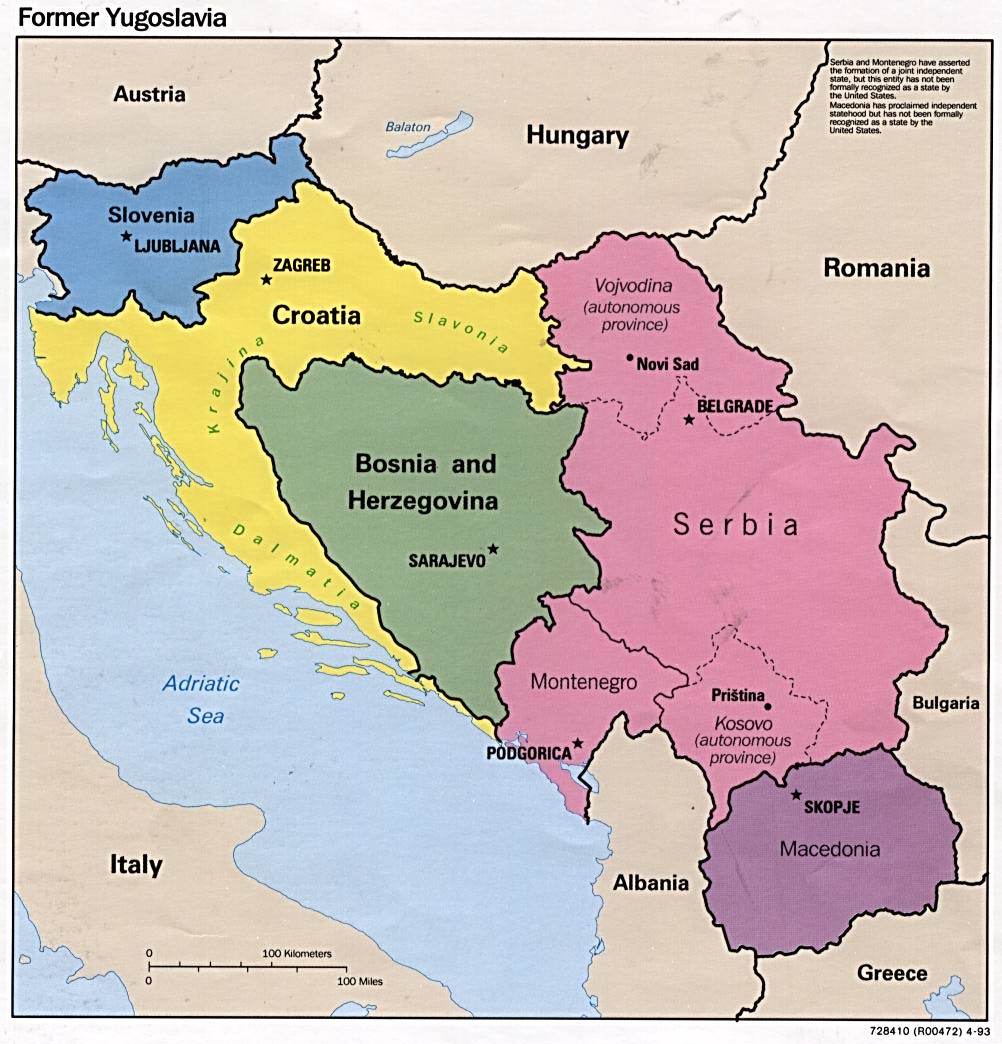
1. After learning about how the Bosnian War began and the role of Karadzic and Milosovic, was it fair for the Independent to use the word "Monster".
2. How do you think this phrase would be justified, according to Plato? Use specific examples from the reading and the documentary, The Death of Yugoslavia, to justify your claims.
3. When the term Monster is used, what do you think it means. (You can look it up in the dictionary, but as you know, that has limitations).
It will be important to skim both articles again, in light of what you now know.
4. Has your answer changed since your first entry? Why or why not?
Your entry must be posted by Wednesday, Spetember 9th to receive full credit.
Tuesday, September 1, 2009
Karadzic is a Monster? How do we know?
Please read the Peter Maas article from Love Thy Neighbor and the Independent article on Radovan Karadzic. Please be aware that the descriptions are graphic. If you do not wish to read the articles, please e-mail me and I will give you an alternative assignment. Please answer the following question on your ToK blog by September 3 for full credit. (10 pts)
The Independent refers to Karadzic as a "Monster." Think back to last year and consider: "How do they know what they know?" How have they attempted to justify their knowledge claims? Please be specific.
The Independent refers to Karadzic as a "Monster." Think back to last year and consider: "How do they know what they know?" How have they attempted to justify their knowledge claims? Please be specific.
Subscribe to:
Posts (Atom)